Showing posts with label Tanzania. Show all posts

Saturday, December 22, 2012

Pictures (last of them?)


Fauna


Marabou Stork, Entebbe, Uganda

 Kampala, Uganda


 looking episcopal at the kizara center
Tanzania

 More fauna

 Bar/Internet Cafe at the White Parrot 
Korogwe, Tanzania


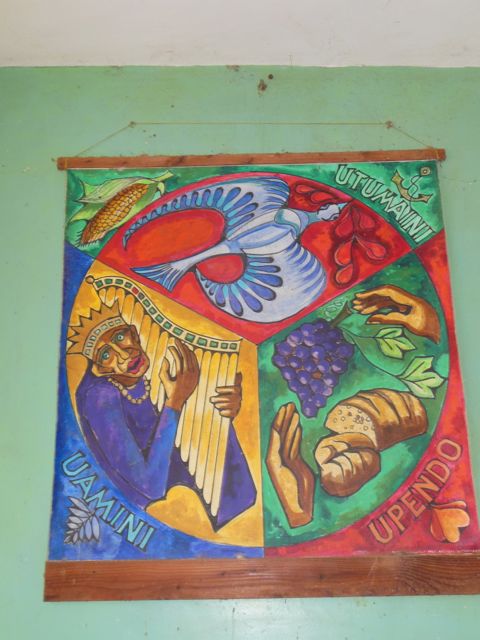
 Faith, hope, communion at St Barnabas house 
 Korogwe, Tanzania

 Swahili Introductions
Tanzania

Sleepy girl--my favorite picture
Kasese, Uganda

Video: Welcome to St Alban's Parish, Ngombezi, Tanzania


Video: Wow and a Swahili lesson

The view to the sea from the mountains in Tanzania--
more proof of Shadrach's labeling of Americans as "the wow people."


A Swahili lesson with Angelina and Colin


Music from Kuhurio, Tanzania


Video: Choir from Kihurio


Singing from Kihurio

Video: Cathedral Kids 2


Video: Kids at the Cathedral School, Korogwe, Tanzania


Video: Sara Blessing the kindergarten


FYI--"hisself" is not a term customarily used in prayer.  oops.

Monday, December 17, 2012

On the way home, being a stranger with candy, and so on


Schipol airport, Amsterdam.

On the way home
I’m sitting in the “library” in the airport—“we invite you to read, download, and explore Dutch culture”—there is also a note that says politely that the sleeping area is upstairs. I’m sitting at a long counter with 20 other people, all of us industriously attached to our devices.  I just drank water from the tap and displayed in front of me sits a book entitled “Dutch Delftware: Vases with Spouts/Three Centuries of Splendor.” What a contrast.

Of our group, Tom is the only one who has been to Africa before (and already has plans to be back in 2013), and I think the remaining four of us are struggling a little to figure out how the last two weeks will assimilate into our “regular” lives of busy-ness and privilege.  We are clear that there is a lot to learn; how the groups we’ve met fit into their wider networks of advocacy and service, how these relationships will be sustained, and how we can best use our resources to help.  And we have fickle hearts. In Tanzania what we were doing seemed so important, and it is, but the level of fundamental need in Uganda was even more staggering.  There are still landmines left in the hills near Kasese, and war and AIDS have decimated the social structure.  There are so many places where it just seems like there are no adults; there just aren’t any.   But I also would love for all those churches not to have dirt floors, and I also have faith that those relationships will deepen.

It’s hard to compare the experiences of each country as well. The Uganda time couldn’t be more different than Tanzania, though each casts light on the other. In Tanzania, our interactions were almost according to ritual; we came, we did church, welcomed, thanked.  It was glorious. But it was mediated in a very distinct way through that structure. Held in the container of shared faith, it was easier to feel connected and to have a kind of narrative thread to hold it all together.   Even though we interpreted the ideas differently, the church provided a common language.  In the Sunday service on our last day, when I was at the altar with the priests there I could feel in my bones that yes, there is all kinds of sin and inequality and injustice, but that there is a unity below it that can transcend everything.  Or at least it feels like it can.  I do, after all, have a BA in gender studies, and am very aware of how power and privilege and difference get in the way of real community.

In Uganda, there’s still plenty of praying (each workday begins with a 30 minute long staff chapel service, where one of the staff offers a short meditation). And of course our shared faith (no matter what the institutional churches say about who’s going to hell) offers a link. And of course everywhere, whatever belief or lack of belief, mediated--or not--through a religious tradition, love and respect and mutuality are always a gift.  For my personal preferences, though, the girl with the incense brings me to my happy place very quickly.

So we all have a lot to learn.  Like any organization founded by a strong leader (and, in this case, named for him) succession and leadership development and institutional growth is a challenge. BMCF, though, is an international organization with an American board as well as a Ugandan one, and all of our time with them was very smooth and strategic.  We had a meeting with “stakeholders” (teachers and students), were intentionally introduced to the present and future focus in the healthcare and children’s programs with personal contact with intentionally representative groups. The BMCF is not a bunch of naïve people singing about Jesus who just want to help.  So I guess the familiar language of the nonprofit world offered some connective tissue, as does the wonder-filed passion of those who are doing the work. And Jesus.

On being a stranger with candy—a lot of candy.
Looking back over these posts, I set out with a fairly nebulous sense of purpose on this trip. I wanted to go. I fretted about what I bringing in my suitcase—candy and bubbles are, in some ways, literally useless (there was also paper and colored pencils, which for sure are more practical).  Being with kids who have very limited opportunity actually to be kids, though, “useless” kids stuff takes on a whole new significance. 

It felt awkward to be the one with all the candy—more on that below—but seeing the kids was delightful. Those kids have so many adult-sized problems, and to see them just having fun and simple pleasure is a big deal.  A lollipop won’t bring back their dead parents and the bubbles pop right away. But to have a few seconds to focus on something else counts for something.  I think one of my landmark moments was seeing a one year old at the clinic waiting for vaccinations with a lollipop in each fist while breastfeeding. Embarrassment of riches!

At first, it felt very awkward to show up as a random stranger with goodies.  I felt so acutely the power dynamic of being the “have-er” in the midst of the “want-ers.”   I decided who had already gotten one and was fibbing about collecting for “my sister,”  and I decided who got one next and when everything got put away. And you know what? Yes, it’s uncomfortable.  I don’t enjoy feeling needy, either, though it happens often enough. I need one of those meme pictures of Willy Wonka with him looking condescending, saying, “I can’t wait, tell me about how your privilege makes you so uncomfortable.” I’m flying home to dressed and healthy children, with whom my greatest complaint is their reluctance to brush their teeth at a sink with running hot and cold water after a meal prepared indoors. Really? Uncomfortable? Do tell. 

Yes, I’m uncomfortable, and that’s important.  I heard a quote from Rabbi Abraham Heschel about inequality recently: “Few are guilty, but all are responsible.” I did not create a colonial empire that abused individuals and families, aided and abetted genocide, and continues to hobble emerging economies through its aid and foreign policies.  Send US grown grain to a poor country? Of course! But what happens when all of that “free” food floods the market and the bottom falls out for local growers? Oops. Our entire government didn’t think of that, did they.

So, yes, I did not personally create the market conditions for poverty or the social conditions for an AIDS epidemic. But given the sheer quantity of “getting” that I do, there is a lot more giving to be done. And inviting others into it, and saying, yes, it really does look like the pictures and yes, these are beautiful and funny and smart kids who have just as much a right to flourishing and imagining their future as mine do.  And, by the way, global warming: you can bet that the drought in Tanzania is caused directly by the climate change that our car-driving, single-serve package, new-stuff-buying lifestyle. And I am both guilty and responsible for that.

Grace, anyway
Still, I think of those moments of church in Tanzania, or the 45 minutes I spent with Pree sleeping on my shoulder or Amy surrounded by kids doing the hokey pokey. There have been transcendent moments where time stands still and all of the separation melts away, where holiness pushes aside all of the brokenness and pain and guilt and the sky opens.

As a Christian, I understand those times to be Jesus moments--Jesus was always pulling people in who didn’t fit in other places and making something new.  Whores and bad guys and, yes, kids, were at the center of his mission—to throw open the doors and let absolutely everybody have the life and grace that he knew was their birthright.  As children of God all of us, imperfect and needy and making bad choices all over the place, are loved and treasured no matter what the world says.  There’s forgiveness, there, both for well-meaning but often clueless do-gooders as well as for the adults who have let these kids down. And for them, a promise that poverty and illness don’t have the last word.

I have been away from home for 16 days—at least 4 of those on a plane or bus trying to get somewhere. So I don’t pretend to have any answers after two weeks. I have a lot of questions, and a lot of interpretations. Spiritually, I know the places I want to return—to that moment of being completely cracked open and flooded with light in that church in Kihurio, Tanzania, where all the women and some men and lots of kids came out singing to meet us on the road and brought us in. I want to return to that moment of eating together, of communion and being joined in the mystery of sacrament and silence and riotous music in Amboni.  I want to return to the love in Ann’s eyes when she talks about her seven foster kids and the future that’s possible for them, one of whom came to her at just a few weeks old, for whom she is all the mother she has had.   And all of those dirt floors swept clean and all the prayers said in gratitude for whatever we have been given, no matter how small. And I want to hang on to the requests—Bahati, one of the teachers at a school that has kids sponsored by BMCF, who sent us a meticulously handwritten note asking that we double our support, and Kizara’s need for hospital beds at the clinic up in the mountains, and even the housekeeper at the hotel where we stayed who asked us for money for a suitcase. I want to be on the hook for that, to remember to tell these stories and not just come home with some lovely baskets and a sunburn, but a mission and a hope for the future.


Finally,
Finally, I want to remember to be moved.
We heard about the Newtown killings in a text message to Tom from Mally at the diocesan office, and spent the day on the road wondering what had happened. As the details emerged and it got worse and worse, all we could do was be silent and remember that there is insecurity and danger, even at home.  Our culture does not have a lock on communitarian goodness or even any claim to functional society by a longshot.  Next, of course, was to question why our country doesn’t have meaningful gun laws. Not asking that question is a little like getting sick from bad food and then going back for seconds and wondering why you got sick again.  Not politics, causality. Nobody needs an assault rifle. Nobody.

So there has been plenty of Good Friday, but we have also often noted how without the blare of Christmas music from everywhere, Advent has been quite a different prospect. Heaven knows that the amount of time we’ve spent in the car has been an excellent waiting discipline. So Christmas is in a week—that moment where the world gets turned upside down and God becomes human and goes to the unlikeliest, poorest place, and lights it on fire with God’s grace and call to peace and justice; a powerless baby telling everyone to wake up and know that everything can be different, that there is enough, that we can be different. 

And for now, that will have to be enough.
Thanks for reading.

Monday, December 10, 2012

Pictures--Tanga, Amboni, and last of Korogwe

 Altar servers at the confirmation service

Spelunking with the Diocese of Tanga

 Bishops and Tom M. at Amboni Caves

 Indian Ocean view from Tanga

 Sunset over Korogwe from my room at the White Parrot

Goodnight, Korogwe!

The Chicken Story

-->
  I'm posting this from our hotel in Kasese where there is excellent internet--yay, family skype time!--so I'll link to a map before getting on with everything else from today.

https://maps.google.co.ug/maps?saddr=entebbe,+uganda&daddr=kasese,+uganda&hl=en&geocode=FTDOAAAdaGDvASmzCsJTt4Z9FzEULMx1w1ClpA%3BFSXMAgAdBQnLASnbueoKLfJhFzFw_syXXXBZJA&gl=ug&doflg=ptk&mra=ls&t=m&z=8


~~~~~~~~~~~~
In the air, on the way to Uganda.  We land at 1:00 and then have some time to rest before we get up for the 250 mile drive to Kasese tomorrow.
I’d planned to sleep but between the turbulence and wanting to look out the window that’s not going to happen. We’re all eating the ginger cookies Amy bought on the way to settle our stomachs.

Leaving Tanzania.  I’ve felt uneasy, somewhat, about sending these words out into the ether; these pages have been so unfiltered and unprocessed and I know I still have a lot of that work to do. But I also want to share what’s happening here and in some way capture the torrent of everythingness,  so here we go.

Yesterday’s most notable event was, clearly, the live chicken.  I’ll back up for a little more context first.

There are two priests on the trip—Tom Mousin from Charlestown, and me—and we and Bishop Tom were all assigned to go to different parishes on Sunday morning to preach.  We arrived in Tanzania late Monday night, so we’ve been here about a week. Bishop Tom was also set to do confirmation; 70 confirmands from two parishes in one monster service. We left our hotel at 7:30 am in two cars. 

I’ve probably not specified that we’ve spent from 2 to 7 hours in the car every day. The diocesan offices and Cathedral are in Korogwe, where we were based, but everything else was down dirt roads and up mountains. Sunday we were all going to parishes in Tanga, on the coast, so we had to get up early for a 7:30 departure.  First we dropped Bp Tom off at his parish, right in the city, where the service was already in full swing at 9:15. Then we went to the parish in Amboni, where I was sent. Amboni is also the site of prehistoric limestone caves, which we visited—more on those later.

Colin and Heidi came with me, as well as Canon Peter, to translate. I had some notes for my sermon but had no idea what to expect—they use a lectionary here, but I don’t know if it’s the same. We got a little turned around on the way, so I think we arrived at about 10:00, and the service had already started. They were in the middle of doing a collection so some of the women would be able to attend a Mother’s Union meeting in another town. To up the ante they had a competition between the men and the women (who sit on separate sides of the church)  for who could give more—I think the women won.  Also, highlight of yesterday—girl altar servers! At my church there was a girl thurifer (incense swinger) and at the other church one was carrying a candle. They both had these very tidy little white head coverings—a little bigger than a bandana but not a veil, either. I asked Peter if girls always covered their heads at the altar and he said no.

So that went on for a while—collecting, announcing, etc.
Then I got up to preach! I had made a few notes about Advent; it’s a very different energy to preach when someone is translating so I wanted to be simple.  Peter kept up very well and the whole thing ended up at about 6 minutes; typically sermons are closer to 30 minutes here! But since we missed the part where they do the readings, I had no idea what I was supposed to even be talking about, so it seemed better to keep it short.  And as my friends at Christ Church know, I find brevity to be a virtue.

After the sermon we did our presentation of gifts—we had a set of vestments and paraments (colored robes for the priest and hangings for the lectern and chalice)—and they gave us our gifts, and wrapped Heidi and Colin and me up in fabric.  They did the general collection and people brought money up to several boxes at the front of the church. Others brought bags of things—fruit and vegetables—and one plastic bag that I noticed the woman tuck the head of a chicken into.  So the chickens and the food and everything were just on the floor in front of the altar. I was a little worried about them having enough air, but forgot about it and they stayed pretty quiet.

Joseph, the priest of the parish, invited me up to the altar at the prayers for Communion, which was so, so lovely. As I’ve mentioned before the liturgy here is very “smells and bells,” so it was chanted and I followed along as best I could. Dominique, the area dean, was also there so we were 3. We had communion ourselves and Joseph gave me the bread to give out—again, wow (as Shadrach teased us, yes, Americans are “wow people.”  Anyway, after having been on sabbatical for three months I’ve really missed being at the altar, so I was kind of ecstatic about that.

Then, communion—continuing in the sky high piety trend, everyone opens their mouths to receive the host, so the trick is to kind of shoot the wafers in without touching their lips. Which mostly I was OK with.  Then after that, the priests wash their fingers with water over the chalice and drink it in case any stray bits of the bread are stuck to your fingers. I clearly showed my, ahem, informal habits when I had no idea of what Joseph was trying to get me to do. So now I know for next time. Mea culpa to all the Jesus bits that get vacuumed up at Christ Church! Yes, of course, I do believe that it’s really the Body of Christ, but, but, but. That conversation is for another day. Then the sky opened and it rained and rained, and seeing the girl with the incense on the other side with the open windows (the church is unfinished, with a dirt floor) was heavenly. I didn’t need to think to hard about how God was there, just that God was.

Back to the chickens.

After communion, we said some more prayers and went back to sit down.  The priest started talking and Peter translated for me—“Every two weeks, the parish brings things to support the priest—they bring some food and things that the family needs. And today, they have some thing for you.” So—MONSTER grin on his face—Joseph came over with the bag. “We would like to give you some things.” Out comes one chicken for me, and then one for Peter. Pictures were taken, and they went back into the bag and back to the altar.   They also gave some vegetables to Heidi, which were less photogenic.

After the service, we had more introductions, a history of the parish, a list of things they hoped to do.  The diocese of Tanga has a very impressive “Vision 2025” plan, which lists all their mission goals and how to accomplish them. So, complete with price list and all specifics, we heard about concrete and floors, and buying the space next door to expand, and the women’s saving and lending co op they wanted to re-start, etc. etc.

I said it after our first meeting at the diocese and I’ll say it again—this place is wicked organized. They know where they’re going and how they’re going to get there and the help they need, which is so exciting because there’s a deep sense of building relationship in going somewhere together. This is not just asking for stuff. I was struck by our parish visit on Sunday as compared to the one the day before; we were there on their terms, their regular service, rather than a special meeting in the middle of the day.  They asked about how much it would cost to travel to us, and Heidi talked about how youth could be involved together.  It feels like this trip is witnessing the beginning of something, though of course Colin and the Friends of Tanzania 3 parish group has been working on this for a while, as well as the Diocese of Ohio and an English group from Hereford.

Shadrach, ever the man in charge, told us it was time to move along, so we obediently got in the car to go meet everyone for lunch. “Aren’t you taking your chickens?” Haha, we laughed. But then we were actually in the car, and someone handed the bag through the window to Peter. Chickens it is.  So there they were, sadly staying in the car (in a bag, feet tied), through lunch, through our tourist visit to Amboni caves, and back to home.

Lunch was great. More gifts. More delightful people.
The caves, on the other hand, were both impressive and terrifying.

Let me now say a word about Bishop Maimbo, who is, no exaggeration, a rock star. When we went to Kizara he kept jumping out of the jeep he was riding in to go on top the road and direct the traffic and hold branches back as we rambled through the rain forest. In his purple cassock (ankle length robe worn OVER pants and clerical shirt—did I mention it was 85 degrees? No? Surprise. Africa is hot). In the caves, he bounded forward (again, cassock), climbing up and down and back and forth. The tour included one passageway that was so tight that Bishop Tom broke his glasses, I started to get a little woozy, and we all worried that 6’4” Tom wouldn’t even fit though.  There were also a lot of bats.  Apparently snakes, too, but we didn’t see any and that may have been Shadrach teasing us.  Unperturbed, the man Amy dubbed “Bishop Macgyver” lead us forward.  He kept asking us if we were tired and then making us do more things. Did I mention the diocese is ALSO wicked organized?

Back to Korogwe, another 2 ½ hour drive, to shower before dinner and a meeting. 

It feels like I should offer some profound summing up about our dear friends in Tanzania, or some grand gesture about  leaving there, but since I know the story has not ended and we’ll hear more from them, I’m just going to leave it there.

And the chickens? Last night Shadrach assured us he’d taken care of them.

What I didn’t expect was that that meant he’d fed them and put them in a ventilated carboard box and tied it to the top of the Jeep. Seamus, pray for us.


Sunday, December 9, 2012

Pictures--Kizara and Amboni

 St James Amboni

 St James Amboni

 St James Amboni
 Procession at Kizara Health Center

 Procession at Kizara Health Center
 Shadrach

Joel getting me ready to bless the kindergarten

Saturday, December 8, 2012

December 7 and 8


From December 7
Yesterday I though that the leper community was out in the middle of nowhere.

Today we went further: to a tiny village called Kizara up in the mountains. We first had to go up and then around a mountain to get there, about a three-hour drive on dirt roads. We went for the festive opening of the new health center, complete with dancing, liturgical parade, and DIY aspergillium (holy water sprinkler—leave it to Anglicans to conceive of a special device for getting people wet in a ritualistic way): a plastic water bottle with holes cut in the top: amazing and brilliant. Yesterday at Holy Cross when we were blessing stuff we had a “real” one. By the way, I use branches at Christ Church.

The health center has a maternity ward with an unfortunately BRAND NEW 1800’s style delivery table with stirrups and all— I said to the bishop, “Really? We paid for that? Consider gravity. We need to send them a nice big birthing ball. “ I think that’s more of an image than he wanted, but it was that kind of day. Then on to the men’s ward, pediatric ward, etc.  Each room could fit four beds. The center was funded with a constellation of grants from the Japanese  Government, the Anglican Church in Tanzania, and the Episcopal Church in the US (DioMass Jubilee Funds as well as the parish partnership for Tanga:  North Attleborough, All Saints Brookline, and Trinity Melrose and the Episcopal UTO grant program, which is paying for the completion of solar panels).  

When we arrived, the choir was already singing and dancing; it seemed like there were several choirs, some with uniforms and some not. I was invited to come and dress up with the rest of the clergy. I was the ONLY woman amongst 12 male priests and 2 bishops and 6 altar servers (not ordained).   That’s 20:1.   After they got the generator settled (no electric lights, but an amp for the music), we all processed in by twos—crucifer (cross bearer), torches/candles, thurifer (incense), some extra guys, all the priests and both bishops and the choir,  separate sections of men and women, which walked in a kind of dancey lock step I couldn’t follow. Twenty one people at the altar today, and I was the only woman. 

So today was the day it hit me—women really, really, really are not at the table here. 
When we visit a somewhere each person in the visiting group and a few of our hosts all get up and say something. For us, it’s usually a combination of our names and homes and a botched “Bwana Asifiwe,” which means “Praise the Lord.”  I don’t particularly every say that at home unless it’s in something I have to read out loud, but I’m a bit flexible here.  Just like when I blessed the kindergarten yesterday I accidentally used both a masculine pronoun for God AND bad grammar—“who gathers us to hisself”—mortifying)

Anyway, back on track.
So each of us introduce ourselves, and the bishop and others have remarked to me that the women’s faces all kind of shift when they find out I’m a priest.  I always say that I have two children who are at home with their dad, so they won’t think I’m a nun.  I stopped saying “and my husband is a priest” when I realized that Tom, the other priest from our group, isn’t able to say “and my spouse is a priest also” in this place. (Side note: both the bishop, Tom Shaw, and Tom Mousin, the priest, are travelling. For extra special, Tom’s spouse is also named Thomas).  Tanzania is not as bad as some places for GLBT issues, but it is not Canada, either.

Back on track AGAIN!
Some of the contrast today particularly was that the liturgy in Tanzania is very “high;” incense, bells, extreme ritual piety. So somehow being the only woman in the middle of that kind of show really drove it home: this is not your place. But because I am a priest, it is. I feel that identity in my bones as much as being a mother and being easily sunburned.

I sat next to Tom the priest—all 6’4” of him and me and Canon Peter, our translator, on a very narrow bench, for three hours. Both Tom, our bishop, and Bishop Maimbo preached, and we all had introductions, and the parish council had introductions, phew.

So I was sitting up there with all those men, and when communion came I was not invited to help distribute (though there were so many of us of course not everyone could, but the two ordained men in our group were). So I sat there, in this middle space of “this is not my place/no, this really IS my place” and thought about all the women who get up and cut firewood and cook and clean up with no electricity or running water in their homes,.  And the way some of them looked at me—and they weren’t looking at me, they were looking at my collar—was like, “Wow, this is possible.”  One of our fellow travellers went for an early run with some African friends of friends, and, again—women see something new, and they see something new about themselves.  This whole space of agency that had been closed to them opened, just a little.   The French feminist Luce Irigaray calls it a horizon for women’s becoming. 

I could see the women there getting just a little piece of it, and I felt transparent and both me and not me. This is so hard to articulate, because I don’t feel as though I, uniquely me (sunburned, mother, etc) have anything to do with it.  In the same way as my children are solely themselves and not mine, stepping into this role of being a priest also is me but not mine.  Both men and women here have this desire for a different vision of church where half their members aren’t disenfranchised.  They’re going to get there. Balancing all that weight through the forest on their heads, surely that skill will translate.

I know so well that getting to that first woman priest will only be the tiniest first step—that we in the American church still have a ways to go. But today-- kids wanting their pictures taken, and random people trying to communicate with their hands they wanted a blessing, and the women who saw me and said, “Yeah, we are going to get a piece of that action.” —whew.

Then we drove back down the mountain through the rain forest, and it was very, very, very bumpy and very, very, very beautiful.

From December 8

Today: Trip to St John’s Kihurio, a smaller group: the area dean, Joseph;  Shadrach, driver extraordinaire; Tom Mousin, rector of St John’s in Charlestown; Angelina from the diocese; and Heidi, the youth leader from Duxbury, and I set out for the desert.
I guess I haven’t said, exactly, who’s travelling in the wider group.
For the first few days in Tanzania, we also had Bishop Mark Hollingsworth of Ohio, and the diocesan chancellor, Bill. Ohio has very strong partnerships in the region, and has for a long time.
Other folks in the group—Tom Shaw, Bishop of Massachusetts; Tom’s sister, Penny, who lives in Louisville, Kentucky; Jackie Drapeau, Tom’s assistant; Amy Whitcomb Slemmer, a lawyer and executive director for Health Care for All, a nonprofit advocacy group in Boston;  and Colin Johnstone, one of the key lay leaders in the Massachusetts parish partnership “Friends of Tanzania”  (he’s from All Saints Brookline). Colin is English and retired to Brookline 5 or 10 years ago with his partner.  He’s been here four times and really knows his stuff.  

Can I say a word about having a driver? Yes, it sounds like a luxury. But driving here is an incredible skill, and Shadrach is an expert, not only at driving but also translating both English/Swahili and cultural Tanzanian/American. He lives in Arusha and takes safari tours through the parks on assignment for 7-15 days, and has three kids: Wesley (since he and his wife were watching a Wesley Snipes movie when she went into labor), Shapiro (a daughter born when he was on safari, named after one of the tourists who came with him to the hospital to see her for the first time so he could get there as soon as possible—I hope they stayed in the car), and Chelsea. For Chelsea Clinton, naturally. 

We drove way out—again, way out—this time not up into the mountains but to what looked like the desert.  You could see how all the culverts and brooks would fill with water when the rain comes, but for now everything is dry, dry, dry.

Let’s talk about water for a moment:
Tanzania receives enough rainfall to fulfill all its water needs.  Even in places like we were today, people can still go up into the mountains to get clean water from the springs there. The problem is one of distribution; for places that aren’t near water, like the leper community we visited on Wednesday, there needs to be a way to harvest and keep the rainwater. Up in the mountain village where we were yesterday, the water needed to be piped in from higher up, again, to ensure continuous access, and that’s another project in progress. As I mentioned before, this year the rainy season did not fulfill its promises, which throws a wrench into the principle of abundance. The long rains will come in March, hopefully.

So we drove out through a valley of thorn bushes, and got out of the car and into the welcoming custom that just cracks me open and fills me with light.  Everyone comes out to meet you, singing and dancing, and as you walk into the church everyone shakes your hand or kisses your cheeks. And people are so happy to have visitors. In more than one place someone has talked about the story in Genesis where Abraham and Sarah are visited by strangers who turn out to be angels, because you never know.  And it cuts through all of my cynical posturing; yes, people really do believe that others are a blessing.  And their thanksgiving is a blessing. During my little intro today I embarrassed myself completely and cried a teensy bit when I said that they have treated us like angels but that they are the angels in how lovely they’ve been to us. Sentimental! But I meant it.  Travelling far from home is always like that—putting yourself in the midst of uncertainty always has a mystical quality in which holiness seems to ensue whether you expect it or not.

Today’s visit was different from our other parish visits because we were a smaller group and the “teams,” as it were, were more even; we had three Africans and three Muzungu coming from outside the community, so we weren’t quite so disruptive.  After the singing and introductions, we went out into the village to meet some of the widows. One lived in a thatched roof two room house with three chairs and some chickens, one lived in a brick house, with a large bed (which she kindly invited Heidi and me to sit down on with her—it filled most of the room), and one in a somewhat fancier concrete block compound style house with her daughter in law and grandchildren.   In each home we introduced ourselves and prayed a little. The dean kept assuring us that they were chosen randomly and were people that would have been visited anyway. All had dirt floors, which brings me back to the church conversation—the floor.

After our introductions, one of the members of the parish council read a history of the church (it’s been there since the 1920’s, but the current structure was started in 1998). He then offered a comprehensive list, with prices, of all the work they hoped to do; the church (unlike the one yesterday) has electricity, but a dirt floor. So they want to level it with concrete and put tile down, as well as plaster it and put in windows.

 We were then invited to make a response; I said there were over 180 parishes in our diocese and we would look forward to telling the story of their church, and hopefully it could become even more beautiful.  I didn’t want to promise anything since I’m totally confused by the exchange rate and the very high numbers (one dollar is 1,500 shillings, so one million shillings is $667).     

Driving, back, we pulled out a calculator and figured out that the floor project would cost about $2,000. Even shooting for the moon and doing everything they asked for was around $6,500, though I’d probably give some pushback on the windows. None of the churches we’ve seen have had them. The walls are thick concrete block, so it keeps rain out and allows air in.  Plus St John’s had a lovely lattice pattern in the bricks and you could see the flowers planted outside.

So that kind of floored us and I immediately started thinking about who I could hit up for some money.  It’s not large-scale social change, but it’s what they asked for.  There are relationships to be built and transformation and dreaming to ensue on all sides, but whether Heidi succeeds in getting her youth group here to lay the tile herself or if we just find the funds to do it, something will happen.

Dear readers, this part will be continued.

editing note: I have not forgotten about doing some theology about candy! I’ve also been ruminating over sin and inequality today and the impossibility of all of this, so that may also come.  But I’m preaching tomorrow in Amboni and we leave at 7:30 AM so I should go get myself a little more organized. Tonight we went out for barbeque and ordered pork by the kilo, so I will sleep with a very full belly.